
Oxford Previous Residents by Era
House history in Oxford works best when each record is treated as a dated snapshot. The Lafayette County Chancery Clerk's deed index follows conveyances. Tax rolls and land rolls identify assessed owners. Newspapers, directories, and census pages add the household layer. No single source lists every person who occupied a building. Line up the dates instead, and an owner never gets mistaken for an occupant.
| Source | Years It Covers | Where Held | What It Shows |
|---|---|---|---|
| Delta deed index | Current online start not stated | Lafayette Chancery / Delta | Grantors, grantees, filing details, book and page |
| Lafayette tax rolls | 1838-1899 identified series | MDAH catalog and archives | Assessed owner and value |
| Lafayette land rolls | 1883 and 1887 | FamilySearch catalog / microfilm | Owner, section, value, remarks |
| Oxford Sanborn map | 1895, three sheets | Library of Congress | Building footprint, block, and street context |
| Oxford Eagle | 1876 to present | Library of Congress / local repositories | Notices, obituaries, and proceedings |
| City directories | Oxford run not verified | Society, library, LOC, FamilySearch | Potential dated occupant or address lead |
Begin with the current parcel card. That anchors the search when the address is known. For an older building, add map, tax, newspaper, and directory sources one dated layer at a time. The local history room can confirm which Oxford city-directory volumes exist and give a title and year for each.
Oxford Parcel Records for House History
The Lafayette appraisal search accepts PPIN, PARID, owner, and address queries. Its result table supplies owner, address, deed book and page, and a first legal-description field. Note the deed book and page. Write down both identifiers. A PPIN or PARID is a more stable handoff than a name alone.
Remember the card is a tax record, not title proof. Owner displays can lag a recent filing. A mailing address may belong to an estate, trust, business, or owner who lives elsewhere. Treat the result as a starting point. Pull the parcel identifier, tax address, legal description, and deed reference from it. An online field can be unclear at times. The Assessor and Collector can explain the current assessment record.
- Situs address
- The place where the land or building sits for assessment purposes.
- Mailing address
- The place used for tax notices or correspondence. It does not establish who lives at the parcel.
- PPIN / PARID
- Parcel identifiers used to locate the appraisal record and keep similarly named properties apart.
Oxford Address Records in Delta
The Lafayette Delta deed index narrows instruments by grantor or grantee, by book and page, and by filing date. Subdivision, legal fields, and instrument number work too. Search the book and page from the appraisal record first. Save the instrument number and filing date. Also save the instrument type, named parties, and legal description before moving on. Uploads can lag courthouse activity, the portal warns.
The official county deed index page displays its grantor, grantee, and book/page controls on one screen. Date, subdivision, and instrument controls sit there as well. Each field matches the courthouse index. Both searches stay on the same terms.
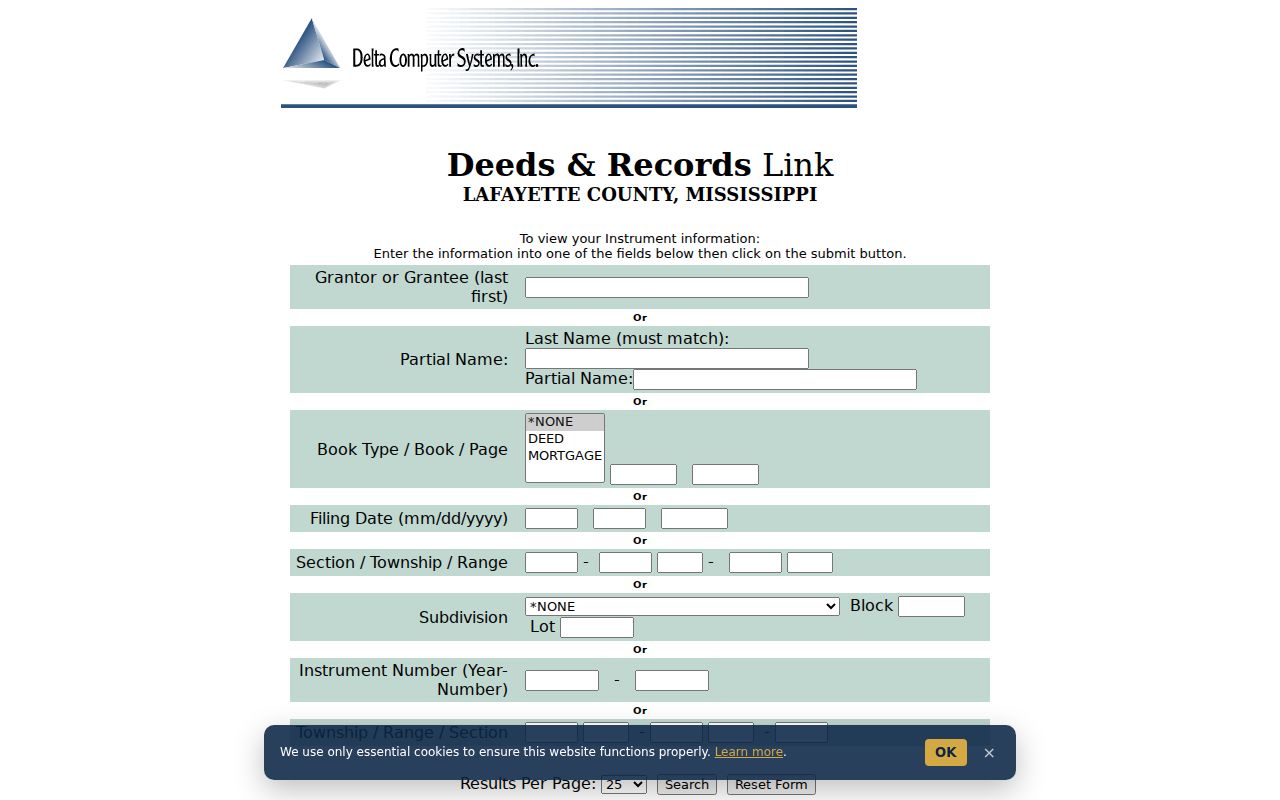
These controls separate a parcel trail from a name trail. That distinction keeps an Oxford address search honest. Request the underlying instrument from the Lafayette County Chancery Clerk when the index lacks context or a certified copy is needed.
Oxford Previous Residents and 1895
The Library of Congress hosts an 1895 Oxford Sanborn map in three sheets, each a snapshot. A sheet can connect an earlier street spelling, block, and building footprint to later parcel research. It helps when an address has changed form. It gives geographic context to legal descriptions.
A map cannot identify an occupant. It shows the structure or block, not who slept there or who held title. Pair the sheet with a dated tax roll, deed, directory, or newspaper notice. Note the address spelling of the era. That spelling anchors later comparisons.
Note: No official Oxford street-renumbering or address-bridge year is published, so treat an apparent address match as an open question until the block, neighbors, and legal description agree.
Oxford Records After Courthouse Loss
Oxford became the Lafayette County seat in 1836. Union troops burned the courthouse in 1864. A replacement was contracted in 1871 and ready in 1873. That history means a missing early record is a source gap. It is not proof that the building, family, or transaction never existed.
For older gaps, two stops stand out. The MDAH Lafayette County finding aid distinguishes archival boxes from microfilm. The Society's volunteers can help identify a title, volume, page, or original repository. Preserve the citation with the result.
Trace Oxford Past Owners by Deed
Title and occupancy must stay in separate columns. The deed chain establishes conveyance parties and the land description. It can lead to an earlier owner, but it never proves that every named party lived at the Oxford address. Move by legal description, not house number.
- Open the current assessor card and save the PPIN or PARID, deed book/page, and complete legal description.
- Use book/page or instrument number in Delta, then inspect the named buyer and seller, filing date, and instrument type.
- Search the seller as a grantee for an earlier acquisition of the same subdivision, lot, or legal description.
- Repeat the chain, checking estate, trust, correction deed, quitclaim, foreclosure, tax-sale, probate, divorce, and plat instruments when the ordinary sale trail breaks.
- When an index image or older link is absent, ask Chancery for the deed book or copy path and use MDAH or FamilySearch catalog material for the earlier record layer.
- Grantor / grantee
- The party conveying land is the grantor; the receiving party is the grantee.
- Chain of title
- The sequence of recorded transfers for one parcel or legal description.
- Legal description
- The lot, block, subdivision, or survey wording that follows the land even when a street address changes.
- Instrument index
- A locator to a recorded item, not a substitute for reading the document itself.
Match Oxford Household Records by Date
Anchor the title trail first. Then compare dated household sources layer by layer. The Oxford Eagle runs from 1876 forward. It appears in the Library of Congress record, supplying notices, obituaries, proceedings, and street variants. Check the page image, and search a surname, former spelling, nearby street, and "Lafayette County."
- Start with an address and a limited date range from the deed or tax record.
- Ask the genealogy room for a directory or criss-cross title/year lookup, including the street number and spelling variants.
- Find the person in the alphabetic entry, then use the street section when a reverse directory is available.
- Compare the directory year with the federal census release for that period, tax assessment, obituary, and recorded transfers.
A directory may name a resident, lodger, widow, student, or business at the address. The census is a household snapshot. Neither overrides a deed without an independent land record.
Oxford Address Records Across Time
An Oxford address rarely matches across records. USPS spellings, city files, parcel cards, historic maps, and newspapers each render one street number a little differently. So compare the details, not just the house number. Line up the adjacent names, cross street, block, lot, subdivision, parcel geometry, and legal description before trusting a match, and remember that an Oxford mailing address may sit outside the municipal limits, where county E911 and Development Services have a role. The EnerGov application guide notes one quirk. A location search may accept “107 Courthouse” when “107 Courthouse Square” fails, because the city database abbreviates streets. Test both variants and log each result. When an older permit or minute book stays out of sight, send the City Clerk a date-bounded request.
Oxford Previous Residents in Households
Ownership is only half the trail. A historical directory can place an occupant at a house number, and a federal census shows the whole household on its enumeration date. The paths through the Society, FamilySearch, MDAH, and Library of Congress are mapped in the Oxford city directory collection guide. Ask for a citation or scan. An undocumented transcription can hide errors with no warning.
Obituaries and cemetery records often close a stalled lead. Search the Oxford Eagle with name variants, and save the publication date and page from every hit. Estate and heir questions point to the Chancery Clerk, who holds the probate and recorded-instrument path. Lafayette County publishes no online probate index. A newspaper residence is a reported historical fact, not a current address.
Lawful use. Oxford previous-resident research is appropriate for house history, family history, heir research, and personal curiosity. Do not use a historical or current record to watch, harass, intimidate, or harm a living person, and do not try to defeat a protected address.