
Oxford City Directory Collections
An Oxford city directory search works best with three things in hand: a name, an old address, or a family surname. Oxford has no single shelf that answers every question, so the residents directory trail here runs through volunteer help, archival catalogs, old newspapers, maps, and county records. Keep the publication date with every result. A historical street directory can place a person in a given year, yet it cannot tell you who owns a parcel now or who lives there today. Compare spellings, street forms, and dates carefully. Only then treat two entries as the same person.
| Collection or lead | Stated coverage | Holding path | Access status |
|---|---|---|---|
| Kerin Coffey Magdovitz Genealogy and History Research Room | Local holdings require a title/year inquiry | Lafayette County & Oxford Public Library | Ask a Society volunteer; in-person and lookup channels |
| Library of Congress directory collection | Primarily 1861-1960 nationally | Library of Congress inventory | Oxford item not confirmed in inspected metadata |
| U.S. City and Business Directories | About 1749-1990 | FamilySearch collection | Search index and inspect image; account or center access may apply |
| Lafayette County tax and land-roll material | Tax-roll series 1838-1899; land rolls for 1883 and 1887 | MDAH and FamilySearch catalog | Reading room, microfilm, or catalog path, not a verified city-directory run |
| Oxford Eagle | 1876-current | Library of Congress newspaper record | OCR and page-image research |
| Oxford Sanborn map | 1895, three sheets | Library of Congress map collection | Building and block context only, not an occupant list |
Oxford directory work therefore starts with a holding inquiry, never with an assumed complete run. The Society, the library, MDAH, FamilySearch, the Library of Congress, and the newspaper archive each contribute different kinds of evidence. A title in a secondary list stays a lead until a repository confirms the edition and shows the actual page or image underneath it.
Oxford Directory Research Room
The Kerin Coffey Magdovitz Genealogy and History Research Room sits on the second floor of the Lafayette County & Oxford Public Library. The address is 401 Bramlett Boulevard. It is a privately owned, non-circulating collection. The Lafayette County Historical & Genealogical Society says its volunteers support the room and field public lookup questions. They can also make copies with source notes. Call 662-234-5751 and ask for the Genealogy Room. Confirm volunteer hours before you travel.
Build a strong request. Include the full name and alternate spellings. Add approximate years and family names. Give a likely Oxford or Lafayette community, and the record type you want. Ask whether a result comes from an original image or a transcription. Ask also for the title, volume, page, compiler or publisher where shown, and the repository. Those details let a later researcher retrace the finding without leaning on memory.
Described holdings include obituaries, cemetery records, Civil War material, and Mississippi maps. There are also family histories, migration and military sources, marriage material, census items, and state or county histories. These companions can explain a gap in the residents directory record. They should not be merged into one claim about a household.
Note: Confirm current staffing by phone, since the older locality guide does not govern present volunteer hours.
Oxford City Directory Archive Gaps
The Library of Congress catalog describes a large national city-directory collection. It is arranged by city and full of gaps. Its metadata lists no local Oxford item and no verified sample entry. FamilySearch offers a strong alternate route. Its City and Business Directories collection holds indexed people and images. But the collection's approximate span is no guarantee of Oxford coverage. Search Oxford, nearby places, surname variants, and an estimated year. Then read the image itself rather than trusting an index alone.
Secondary leads mention Oxford directories near 1960 and 1999. Treat them as finding aids only. No official source establishes a first or last printed Oxford directory year. None fixes a local digitization cutoff or a publisher sequence either. When a volume is missing, record the negative result as "title/year not located." Note the catalog searched and the date. Do not assume the person or address was absent. A gap in a street directory is not proof of absence.
The Library of Congress directory holdings inventory shows exactly why a collection-level result still needs a local check. Only then can anyone call it an Oxford city-directory find.
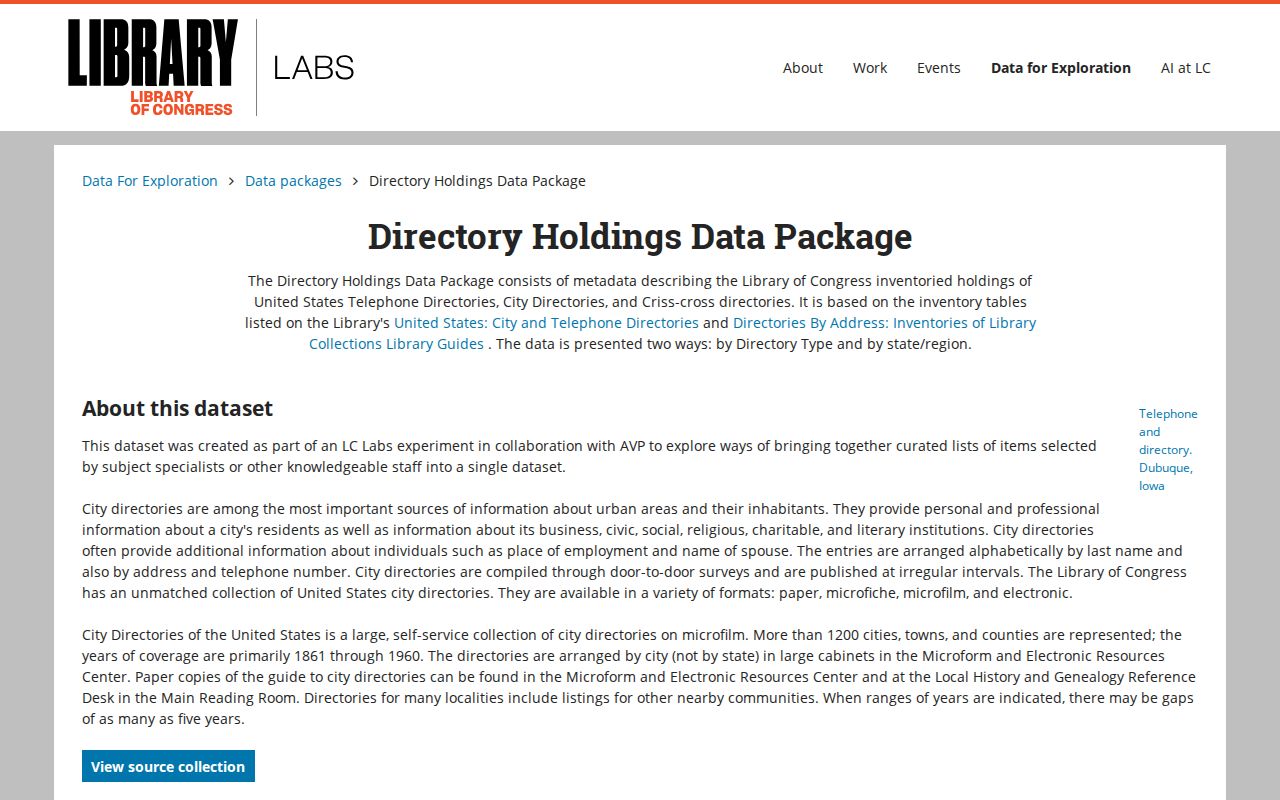
Treat the inventory view as a search starting point. It supplies no verified Oxford volume and names no occupant, so a repository or source-image confirmation is still necessary before any resident lookup conclusion.
Reading Oxford Directory Entries
Copy an Oxford directory entry exactly before you modernize it. Printed volumes may list a surname and given name, a street address, an occupation, a spouse reference, or a telephone entry. Some volumes are arranged by person and some by street. A short mark means whatever that volume's abbreviation key says it means. An entry could be a resident, a boarder, a widow, or a business. It could also be a campus-related address. Never silently relabel one as ownership or current residence.
| Name as printed | Preserve surname, initials, spelling, and any qualifier before matching it elsewhere. |
|---|---|
| Address line | Capture house number, street form, apartment marker, and whether the entry is in an alphabetic or street section. |
| Occupation or organization | Use it as a historical identity clue, not a statement that the person still has that role. |
| Spouse or widow notation | Record parenthetical names and abbreviations exactly because they can distinguish people with the same name. |
| Source control | Save publication year, page, edition, publisher where shown, repository, and image or film reference. |
- Criss-cross directory
- An address-first directory that usually orders entries by street and house number, then identifies an occupant or listing at that address.
- Householder index
- A name arrangement centered on the household reference, which may omit other people living at the same address.
- Abbreviation key
- The volume’s explanation of its shortened terms and marks. Photograph or transcribe it before interpreting any single entry.
Oxford Criss-Cross Directories
A criss-cross directory flips the search. You start from a street and house number. Then read the listing tied to that spot. That helps when a surname is a mystery. It does not close Oxford’s verified-run gap, though. A later local volume may spell a street differently. It may drop an apartment, or carry an older house number. Before treating two references as one place, weigh the assessed parcel, a map, and postal normalization together.
The 1895 Oxford Sanborn map adds context across three sheets. Its building and block detail can show an old address form. It can point to the same footprint. Occupants are another matter. The map names structures, not people. For present-day title and parcel questions, rely on the city’s address-based records on their own. Do not force an old directory to carry a modern conclusion.
When the work turns from a historical listing to a current address record, the separate Oxford street directory lookup offers an address-first public-records route. Keep its modern record date apart from the city-directory date.
Oxford Directory News Checks
The Oxford Eagle record at the Library of Congress covers the newspaper. It spans 1876 to the present. Its historical pages can yield obituary notices, legal notices, marriage notices, business advertisements, street references, and local proceedings. Search a surname with spelling variants. Add relatives, a street, “Oxford,” or “Lafayette County.” OCR is only a finding aid. Read the page image before treating any word or date as evidence.
Obituaries and cemetery records make strong identity cross-checks. They may name relatives, a reported residence, a funeral location, or a former community. None of them proves a current address. An Eagle scan may be missing or unreadable. MDAH and the local Society can supply cemetery and record leads. The Lafayette County Digital Museum adds another Oxford starting point for maps and community materials.

The museum image carries a lesson. Keep the item’s source and date with any local-history lead. A historical image can enrich a city-directory search without ever proving where a person lived in Oxford.
Trace an Oxford Directory Household
Treat one verified Oxford city directory entry as a dated household snapshot. Then move edition by edition in both directions. The aim is to test continuity, not to force every similar name into one family. People move, marry, appear as widows, or board at an address. Some vanish from a listing entirely. Omission happens too. Pair the directory result with a census year, tax material, a deed date, or a newspaper notice. A cemetery reference can fill the gap as the question demands.
- Save the first entry’s title, year, page, spelling, address, and notation key.
- Search the alphabetical portion for the same name and close variants in the next earlier and later available editions.
- Check any street-order section for the address and record every listing without assuming an occupant owned the place.
- Compare the gap between editions with a census household, Lafayette tax-roll material, a deed event, or an Oxford Eagle notice.
- Close the research note with the source image and unresolved differences, including a missing Oxford volume.
FamilySearch catalog material holds Lafayette land rolls for 1883 and 1887. It also holds tax collectors’ cash books covering 1878 through 1898. MDAH’s Lafayette County records contribute archival boxes and microfilm. They add tax rolls, cemetery index paths, and historic-property context. Each system describes something different. Agreement between them helps, and disagreement can matter just as much.
Oxford Directory Dates and Tax Rolls
Directory-year work works best when each source keeps its own date and purpose. A historical address can predate a recorded transfer. A tax roll names an assessed owner and value. A census captures one household snapshot, while a newspaper notice offers narrative reporting. None of these are copies of a single database. Flattening them into a claim of continuous Oxford residence does violence to all of them.
| Source | What it can establish | What it cannot settle alone |
|---|---|---|
| Printed directory | A dated published listing, subject to the edition’s scope and notation. | Current residence, ownership, or complete household membership. |
| Tax or land roll | An assessment-related name, value, and land context for its stated year. | Who occupied a place or whether the assessment is current title. |
| Census | A dated household enumeration. | An unbroken address history between census years. |
| Oxford Eagle or cemetery lead | A historical notice, kinship clue, or place reference. | A present address or a complete official identity record. |
Oxford’s University and city records deserve equal care. A campus, institutional, or University ZIP reference is not automatically a private Oxford household. Preserve the address as printed and identify the record custodian before making any locality claim.
Oxford Directory History Timeline
Oxford history explains why an archival search often needs more than one shelf or portal. The sequence that follows records documented local milestones only. It is not a verified directory-publication timeline, and the official material establishes no confirmed first or last year for an Oxford city directory.
- 1836: Lafayette County was organized and Oxford was selected as county seat.
- 1837: Oxford was founded and chartered.
- 1864: Union troops burned the courthouse; surviving series should be checked with MDAH or the local research room.
- 1871-1873: A replacement courthouse was contracted and ready.
- 1876-current: The Oxford Eagle provides a continuing newspaper path.
- 1895: The three-sheet Sanborn map supplies a dated block and building view.
The courthouse fire is a warning, not proof that every early record burned. The county history never enumerates which series were destroyed or rebuilt. Ask MDAH finding aids, the Chancery Clerk, and the genealogy room for the specific record series and date range you need.